What is the difference between SparkContext and SparkSession?
SparkContext is the low-level entry point to Spark used primarily for the RDD API, while SparkSession is the high-level unified entry point for working with SQL, DataFrames, and Datasets, and it internally contains a SparkContext. Read more.
Is it possible to implement a Kafka consumer so that it automatically determines the format of an incoming message and selects the appropriate deserializer?
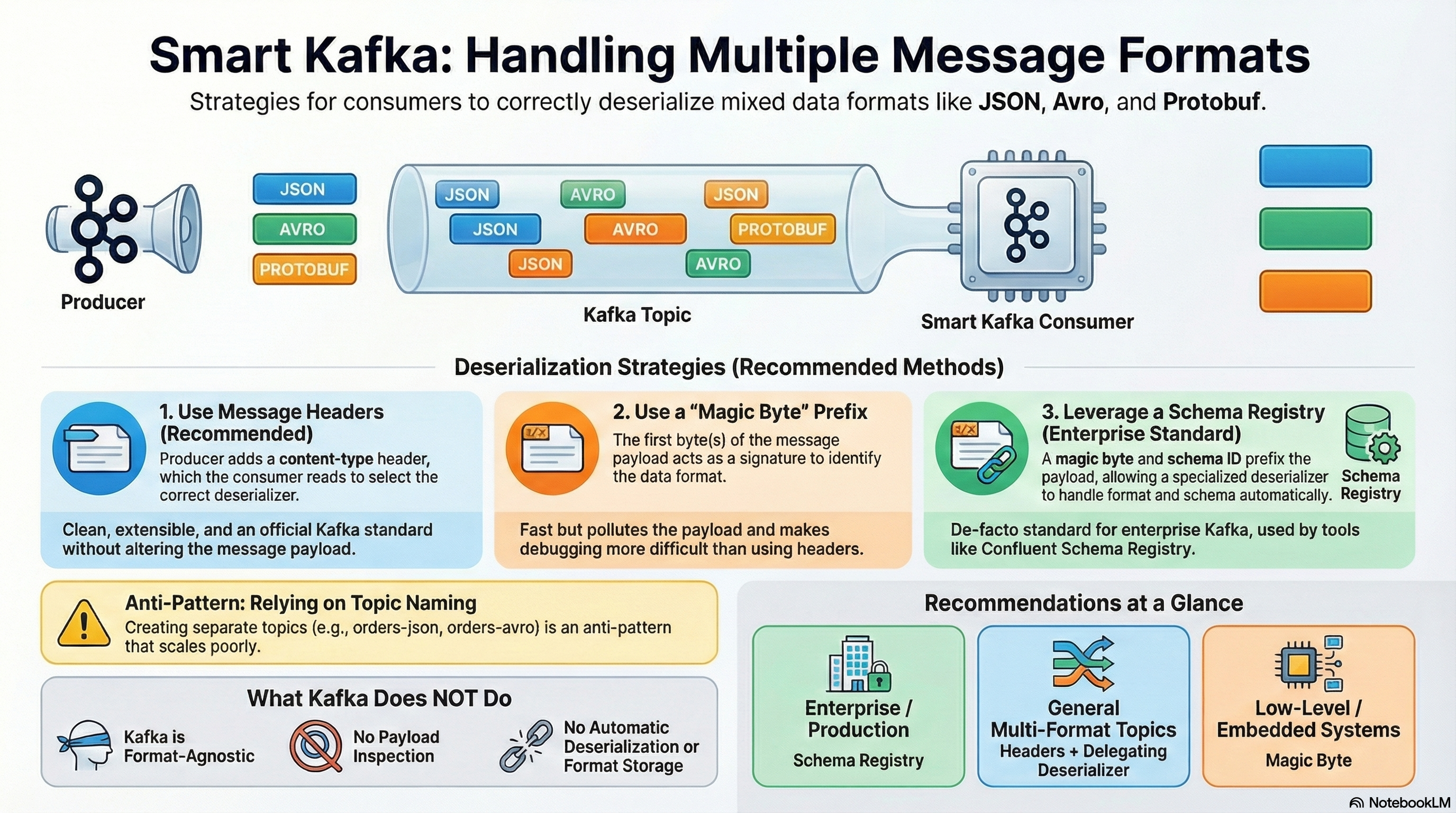
The best approach — headers
Kafka officially supports headers, and this is the best mechanism.
What it looks like
The producer writes the format into a header:
ProducerRecord<String, byte[]> record =
    new ProducerRecord<>("topic", key, value);

record.headers().add("content-type", "application/json".getBytes());
record.headers().add("schema", "user_v1".getBytes());
Consumer:
Headers headers = record.headers();
String contentType = new String(headers.lastHeader("content-type").value());
Then:
switch (contentType) {
  case "application/json" -> jsonDeserializer.deserialize(...)
  case "application/avro" -> avroDeserializer.deserialize(...)
}
Pros
✔ clean
✔ extensible
✔ does not pollute the payload
✔ Kafka standard
👉 Recommended approach
Magic byte / signature in the payload (as in Avro)
A classic approach — the first byte or several bytes define the format.
Example:
0x01 → JSON
0x02 → Protobuf
0x03 → Avro
Payload:
[magic_byte][actual_payload...]
Deserializer:
byte magic = data[0];

switch (magic) {
  case 1 -> json.deserialize(...)
  case 2 -> protobuf.deserialize(...)
}
Where it is used
- Confluent Avro
- Protobuf
- Thrift
Pros / Cons
✔ fast
✔ no headers required
✖ payload is polluted
✖ worse debuggability
Schema Registry (Avro / Protobuf / JSON Schema)
If you are using Confluent Schema Registry, the problem essentially disappears.
Format:
[magic byte][schema id][payload]
Deserializers:
KafkaAvroDeserializer
KafkaProtobufDeserializer
KafkaJsonSchemaDeserializer
They automatically understand the format and the schema.
👉 This is the de facto standard in enterprise Kafka.
Custom delegating deserializer (generic)
You can write a single deserializer that internally selects the appropriate one.
public class SmartDeserializer implements Deserializer<Object> {

  private JsonDeserializer json;
  private AvroDeserializer avro;

  @Override
  public Object deserialize(String topic, Headers headers, byte[] data) {
    String type = new String(headers.lastHeader("content-type").value());

    return switch (type) {
      case "json" -> json.deserialize(topic, data);
      case "avro" -> avro.deserialize(topic, data);
      default -> throw new RuntimeException("Unknown type");
    };
  }
}
Kafka config:
value.deserializer=com.my.SmartDeserializer✔ the consumer “understands” the format automatically
✔ the topic can be multi-format
Via topic naming (not recommended)
topic-json
topic-avro
The consumer chooses the deserializer based on the topic name.
❌ does not scale well
❌ breaks with schema evolution
❌ anti-pattern
❗ What Kafka does NOT do
- Kafka does not inspect the payload
- Kafka does not auto-deserialize
- Kafka does not store message format information
👉 The message format is the responsibility of the producer and the consumer
💡 In short:
| Scenario | What to use |
|---|---|
| Enterprise / prod | Schema Registry |
| Multiple formats | Headers + delegating deserializer |
| Low-level / embedded | Magic byte |
| Streams | Custom Serde |